MyArtBroker runs an Instagram series based on a simple conceit: an interviewer stops someone on a London street — "Excuse me, can I ask you a question about art?" — and proceeds to ask a stranger which piece of art they'd like to own without consequence.
Strip away the underlying promotional vehicle and the vox pop format (which is as old as broadcasting), and what's left is an invitation to daydream. There's a purity to it: a small, harmless fantasy, offered to strangers on the street, that you can't help playing along with. It's the lottery win fantasy without the greed because the answer reveals taste, not appetite.
The least rewarding answers emerge when people consider the most obvious and expensive piece they've ever heard of and then declare that the first thing they'd do is sell it. Greed is ineffably dull and not in keeping with the spirit of the exercise. Someone did offer this answer recently and was suddenly overcome by a moment of self-awareness and how this might be perceived. They hastily declared that they'd use the money to buy more art. Inevitably, the interviewer nodded approvingly and pressed for examples, and the attempt at redemption quickly fell flat when they couldn't name a single piece. I'd run out of money long before I ran out of ideas.
That said, it is difficult to be confronted with an unprompted question on a busy London street, especially when you consider a definition of art and the extent that this encompasses. Perhaps cynicism and the propensity to sell reflect the fact that art has been transformed into an asset class, and this is merely a sign of the economic times we find ourselves in.
It reminded me of a social experiment that played out in New York years ago where Banksy challenged the perceived value of art when isolated from the cues which would suggest its value. All of his offered works were priced at $60 and most went unsold, but of those that sold, all appeared at auction with Bonhams months later once the buyers realised they were authentic. But selling a Banksy for $60 is a statement only Banksy can afford to make. Most artists need the market he's challenging. I suspect he's always known that and never been comfortable with the idea.
'Love is in the Bin' resold in 2021 for £18.5 million after it partially shredded itself at auction - 18 times the original price it fetched three years earlier. Even his protests against the market get absorbed and repriced by it.
I have often pondered the answer that I would give. When I think of prominent artists and their works, ownership carries a weight of responsibility, leaving you merely as custodian with all that entails. You are simply buying the convenience of access. Some pieces are too important to be left in private hands, and in reality, the cost of insurance and safeguarding accounts for why a great many notable pieces in private ownership are on semi-permanent loan to museums. It's simple economics and a form of risk transfer. I'm not denying altruistic intent and the presence of philanthropic goodwill, but there are practical realities to preservation and ownership. This is far preferable to seeing important pieces hoarded as investments. Perhaps never to be seen in public again save when they next cross an auctioneer's block.
My choice would need to reflect human artistry and allow for reflection. Demonstrable craft skill, sheer artistic talent and mastery together with subject matter that resonates. Consider works like Rodin's Gates of Hell or Giuseppe Sanmartino's 'The Veiled Christ'. They are remarkable, and you can't help but be filled with wonderment and admiration, not only in their conception but also in their execution. Sanmartino's sculptural ability and depiction of the cloth veil in 'The Veiled Christ' are otherworldly, and to think he produced it in 1753 at the age of 33. As a figure study, it's an absolute masterpiece, though the religious subject holds little appeal for me.
The great works belong in public, which is why I'd prefer something I could live with every day. Hanging a priceless master somewhere absurd or incongruous, where no one would believe it was real, holds great appeal. David Hockney's 'Dog Painting 17' over our dog's bed, say. I sense that would have tickled Hockney. But my ambitions are more modest.
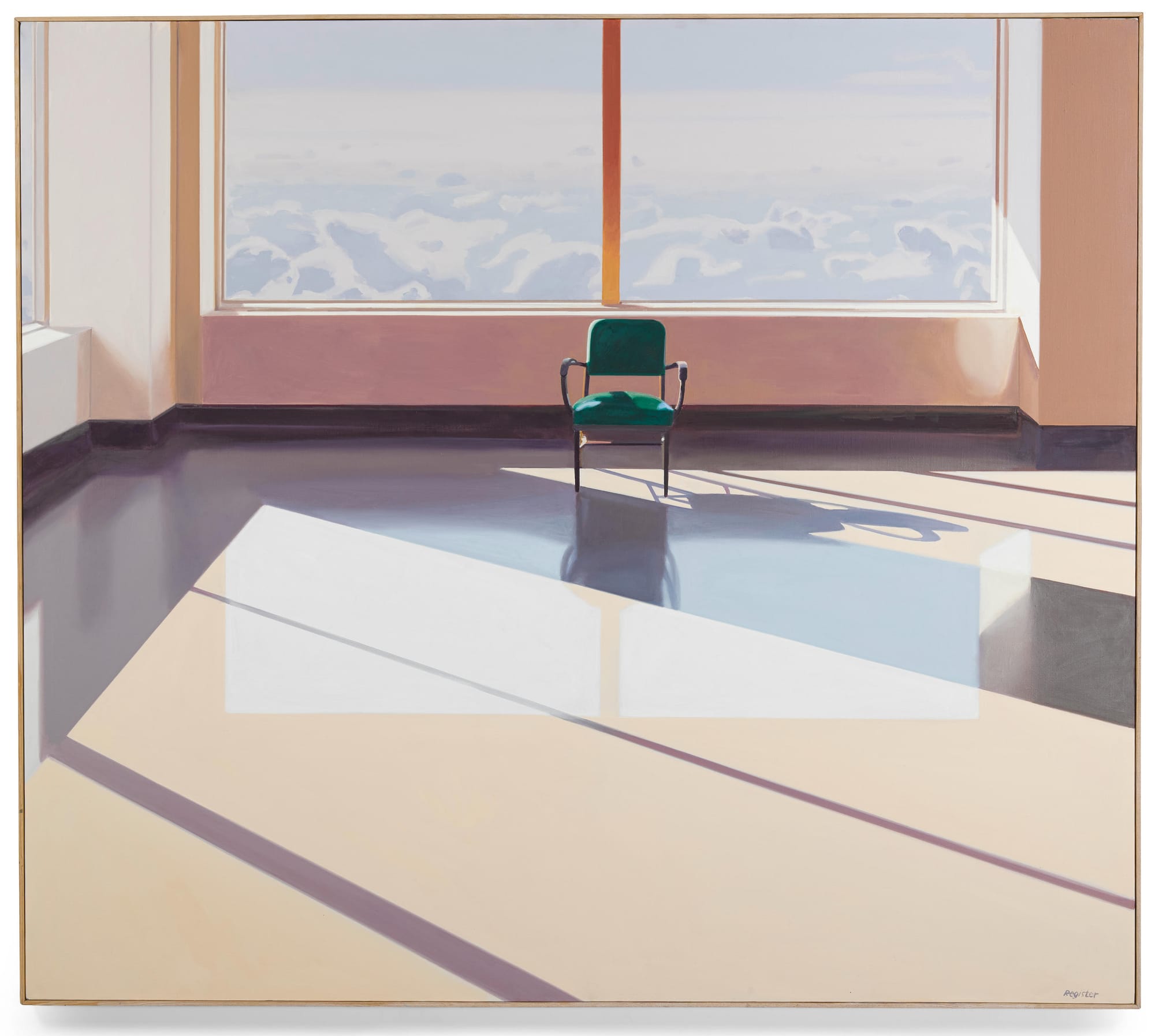
My choice is a painting by John Register - an American realist. He chronicled a search for overlooked beauty in landscapes, and his work largely omitted people. His use of hard light and colour is hugely evocative. Critics have often referenced the fact that his style is reminiscent of Edward Hopper but with Hopper, you witness someone else's isolation. With Register, you feel an innate sense of disquiet and isolation as the viewer. The distinction between looking on and looking in. It's something that resonates for me and is a theme in my own photography.
John Register worked as an advertising art director and, at the age of 33, walked out of a client meeting on Madison Avenue (where he worked for Ogilvy & Mather), claiming that he had a dentist appointment. He never returned. He developed his process while studying under Lennart Anderson and Everett Raymond Kinstler having studied commercial art at the Pasadena Art Center and design at the Pratt Institute in New York which was founded by his great-grandfather.
Register created the majority of his most important works while suffering from terminal illness. He died young at 57 in Malibu, CA. Which makes my choice of 'The Waiting Room for the Beyond' all the more poignant.
I've spent more time than I'd like in waiting rooms of my own at Moorfields Eye Hospital after successive retinal detachments that arrived without warning. I know that particular stillness: the solitude, the seafoam green colour palette of the hospital, and the dread of what comes next, folded into one another. Register painted it perfectly, down to the polished and pristinely mopped floor.