
I watched Ron Howard's documentary on Richard Avedon last night. Making a documentary about any photographer is challenging – in the main, the majority of material will be in the form of still images. Without skilled direction and editing, a documentary can quickly feel like an adorned slideshow. A filmmaker profiling a deceased artist is also limited to what remains – the work and the recollections of those who knew them best.
It seems fitting then that the six-decade career of one of the twentieth century’s most influential fashion and portrait photographers should be profiled by a director of Howard’s acclaim. His own standing no doubt opened a great many doors, providing for unprecedented access. Amongst those, the Richard Avedon Foundation.
Such a collaboration risks serving the archive’s interest in protecting Avedon’s legacy, both in how he is presented and in what material would be allowed on screen. The difficulty is that omissions are invisible: without knowing what the archive holds beyond the acknowledged scale of a long and prolific career, we cannot tell what may be missing or the politics and practicality of what was excluded.
Inherently, the film carries a weight of expectation: iconic artists come with a duty to “play the greatest hits”. The famous photographs must be included, or the film would feel incomplete. The cost is that the familiar displaces the unfamiliar, and some of the archive’s less celebrated material, perhaps its most revealing or interesting, ends up on the cutting-room floor, if it ever reached the edit in the first place.
Howard approached this film in a similar fashion to his other documentaries on Pavarotti and Jim Henson – to explore the creative process of an artist whose work he admired from afar. I can only judge by what is on screen and from my own understanding of Richard Avedon, but on that evidence, Howard understood Avedon, and his depiction feels balanced.
An artist's life and personal values shape their work, and knowing about any harm caused in the creative process will change your perception of them and how you see the work. Claire Dederer argues that this knowledge 'stains' the experience whether you want it to or not. Howard makes plain the toll that Avedon’s single-minded devotion to his work took on those closest to him and on those who worked for him. The film acknowledges this reality but does not linger on his failings.
When Avedon was young, his family staged their snapshots carefully. In Avedon's words: “We dressed up. We posed in front of expensive cars, homes that weren’t ours. We borrowed dogs". The family didn’t own a dog. The dogs were props to make the family look more prosperous than it was. His father’s clothing business had gone bankrupt in the Depression.
“All of the photographs in our family album were built on some kind of lie about who we were and revealed a truth about who we wanted to be.” – Richard Avedon
The dogs in the family’s photographs were often Wire Fox Terriers, a breed that would have been very much in the public eye, with both Calvin Coolidge and Herbert Hoover keeping one in the White House. In the film he calls this “the sadness of borrowed dogs”. The sadness is about the family not being satisfied with who they actually were. This thread weaves into the narrative of his fashion photography as constructed fiction. His formative experiences showed that a photograph is staged, never neutral, and Avedon himself openly declared that there is no such thing as objectivity in photography. He's right. Any artist makes a series of creative decisions through the course of developing their work which reflect their own biases. In that, he was no different from his own family, who concealed the truth behind borrowed dogs.
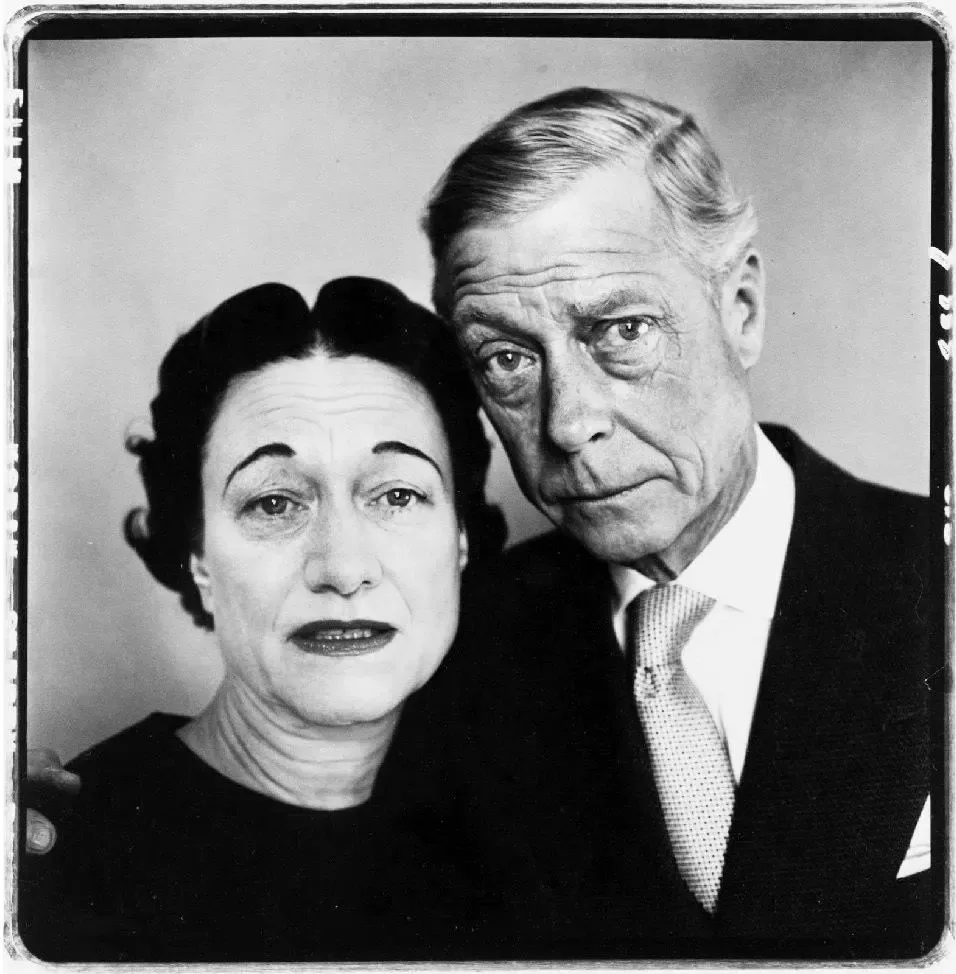
Years later, a dog, albeit an imaginary one, would again serve a lie in pursuit of the truth. In 1957 Avedon photographed the Duke and Duchess of Windsor, the former Edward VIII and Wallis Simpson, a couple famous for their polished public persona and rehearsed smiles. He wanted to pull down the mask, and by his own account:
“I knew they loved their dogs, and I told them, ‘If I seem a bit hesitant or disturbed, it’s because my taxi ran over a dog,’ and both of their faces dropped, because they loved dogs a lot more than they loved Jews.”
Avedon was Jewish and the Windsors were known Nazi sympathisers.
It has been suggested that the story itself may be made up, as Avedon liked to embellish. In Avedon: Something Personal, Norma Stevens, his studio director for nearly 30 years, recounts that Avedon joked that if he ever wrote an autobiography, he would call it Here Lies Richard Avedon. The Avedon Foundation declared the book “filled with countless inaccuracies”. It also called on the publisher “to cease publication, distribution, or any derivative or collateral use”.
So the anecdote about a lie told to get the picture may itself be a lie told about the picture. Avedon fictionalised his own life; Stevens may have absorbed those fictions; and the Foundation is now left to separate fact from fiction in preservation of his legacy.
Many of the Foundation's corrections are simple points of fact, and some may well be fair. Still, it is worth remembering that this is the same Foundation that opened its archive to Howard. I’m not suggesting that the film is a whitewash – it isn’t – but it is shaped by those with a stake in how its subject is remembered.
Much of the film is narrated by Avedon himself, drawn from interviews recorded throughout his life. He also habitually taped his conversations, and these recordings add real depth to our sense of his professional and personal relationships. Such material is a gift to any documentary, and Howard employs it well. But it does mean that we often hear Avedon as he chose to be heard, now in the service of Howard’s depiction.
None of this diminishes the film. If anything, it perfectly suits its subject. Avedon understood better than anyone that an image is a construction and that what it conceals says as much as what it reveals.
Howard’s portrait is warm, intelligent and beautifully made, and for anyone with an interest in photography, it is essential viewing. Just watch it as Avedon would have looked at a photograph: knowing that what you see is real and that it is not the whole truth.
Richard Avedon died 22 years ago, aged 81, yet his work still resonates. Beyond its extraordinary artistry, it reveals an innate curiosity, a fascination with humanity and, perhaps, a search for his own place within it.
As he put it himself: “All photographs are accurate. None of them is the truth.”


