I've been on trains more than I'd like this past week. London for a kickstart of Cambridge Tech Week (the logic of hosting this in London!) and Cambridge for Cambridge University's Centre for Risk Studies annual Risk Symposium.
I also seem to have been talked into a science demonstration day by one of my supervisors - helping to educate teenagers and encouraging them to spend three years studying STEM at UCL. It feels vital in the wake of a Scientific American article I read this week: US Science is in Chaos but there have been some bright points when the Trump administration was forced to reverse its decision to dismantle a $368m deep-sea observation system following an outcry from lawmakers and ocean experts. Algae also had a good week.
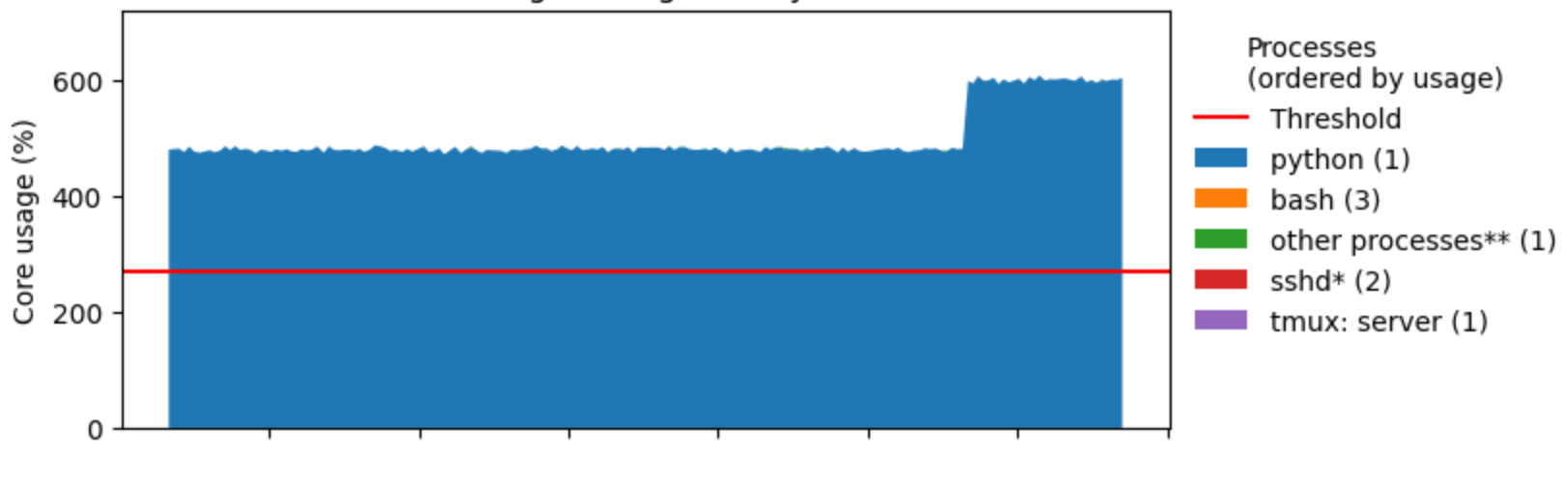
In between, I've spent a second week resolving the quantitative aspects of my research and staring into a terminal window as my interface into the university's research supercomputers. My use was throttled, and I was put on the naughty step for several hours for a coding transgression. IT sent the receipts.
There is an introduction to my research here but I took a state-of-the-art burnt-area model (built on NASA/IBM's Prithvi geospatial foundation model, trained on US fire scars) and tested it across five regions spanning both hemispheres and both fire seasons. In its home domain it scores about 0.81 on the standard overlap metric which is very good. Across Africa, it collapsed everywhere (below 0.4 generally), regardless of hemisphere or season.
The failure has a specific character: the model doesn't miss fire, it invents it. It floods the savanna with false positives, labelling huge areas as burnt that aren't. African dry-season grassland is spectrally different from the dark American forest char the model learned, and that mismatch makes it overpredict dramatically.
I also tested knowledge distillation — the method of compressing a large model into a small, deployable one (which matters for low-resource contexts). The finding: distillation faithfully copies the bias, not the skill. The small model inherits the big model's tendency to over-predict without gaining any real accuracy. That replicated across all five regions.
The part I'm pleased to discover is something that I now retract. I initially thought regional performance tracked how spectrally similar each region's fire was to the training data. A convenient truth. But when I ran a proper confound analysis, most of that apparent pattern turned out to be a statistical artefact of how much had burnt, not a real spectral effect. Knowing this is a valuable foundation to build on. Local data doesn't fix everything – even within Africa, it's hard and the choice of how you balance the model swings it between over and under detection.
I'm currently building a student model but the rest of the research and lines of investigation are firmly within the scope of a PhD. MRes appears to stand for 'Masters Research - Extremely Short'.
Risk Symposium
The symposium adopted Chatham House Rules but I've noted some interesting insights (not exhaustive):
UK Energy System Fragility: The UK energy system faces severe resilience challenges. Fuel poverty affects 11-34% of households, over 28 suppliers collapsed during the 2021-2022 price shock, aging infrastructure poses systemic threats (e.g., the 57-year-old substation causing the 2025 Heathrow disruption), and climate change is reshaping demand patterns.
Decentralisation as a Solution: The energy system is transitioning from a centralised to a decentralised model (on-site generation, batteries, and consumer participation), which offers resilience opportunities but requires a customer-centric view, cross-sector collaboration, and whole-system thinking.
Holistic & Systems-Based Resilience: Resilience requires a holistic, systems-based approach spanning technical, organisational, social, economic, and environmental dimensions, with cross-sector data sharing and governance being essential to manage cascading risks.
Geopolitical & Economic Volatility: Geopolitical shifts, such as China's trade realignment, energy price volatility, and maritime chokepoints, demand organisational flexibility, working capital buffers, and supply chain awareness. Political and credit insurance are crucial tools for enabling investment amid uncertainty.
Resilience as an Operational Capability: Corporate resilience should be treated as a dynamic operational capability, reliant on foresight ("left of boom"), situational awareness, and integrated decision-making, rather than a static maturity state.
AI & Digitalisation Risks: AI-enabled systems and digital tools can introduce new systemic vulnerabilities. They require safety-by-design, robust testing (as early warning systems can fail), governance, and inclusive stakeholder engagement before deployment in critical sectors.
Operationalising Risk Management: Effective resilience requires translating risk frameworks into business operations via clear language on threats, vulnerabilities, and controls. Pandemic responses often masked failures in foresight and integrated risk management.
Insurance Market Nuances: Insurance availability is complex: marine cargo in the Strait of Hormuz remained available but was costlier, while insurers are withdrawing from climate-exposed regions where risks approach certainty. Political risk appetite is constrained by aggregate exposures.