
Introduction
Marking UCL200, the 16th UCL Risk and Disaster Reduction annual conference took 'Cities of the future: risks, resilience and reimagination' as its theme. The day's record London heat, and the wider backdrop of London Climate Action Week, lent the conversations a certain prescience.
This article is a reproduction of a LinkedIn article series, mercifully free of the hateful formatting limitations and lack of imagination imposed by Microsoft.
Every speaker was generous with their time and offered far more than I can do justice to on LinkedIn, so in the interest of brevity, I have serialised personal highlights into three articles and drawn out only the threads that sit closest to my own research and practice areas.
What strongly resonated in the keynote was the importance of social cohesion, nature-based solutions, and integrating indigenous knowledge with technology, while considering the measure of harm that AI poses in displacing local practices if not governed properly. A major threat is also the prospect of "uninsurability", where private insurers minimise exposure and withdraw from high-risk markets, with cascading effects on mortgages and property markets. This is notable in California where an estimated private coverage shortfall of $1.35 trillion to $2.00 trillion exists between total wildfire risk and available protection.
My thanks to Ting Sun for chairing and Joanna Faure Walker for hosting, to the panellists (whom I'll tag in the articles that follow), and to the many fellow attendees whose conversations also made the day.
Keynote - Loretta Hieber - UNDDR

Keynote Highlights
Compounded Risks and Systemic Fault Lines: Cities face cascading risks acting on three fault lines: 1) rapid, unplanned urbanisation; 2) social inequality determining who lives in vulnerable areas; and 3) ageing infrastructure built for a climate that no longer exists.
Social Cohesion is a protective factor: The 1995 Chicago and 2003 Paris heatwaves showed that social cohesion in a neighbourhood was a more significant predictor of mortality than other factors. Neighbourhoods with strong social networks saw lower death rates.
The Gap in Vulnerability Intelligence: There is an imbalance in investment between "hazard intelligence" (prediction) and "vulnerability intelligence" (poverty and housing data). Social vulnerability is a better determinant of disaster mortality than hazard information.
UN (UNDRR) Initiatives: UNDRR is promoting a risk metrics programme to quantify the cost of inaction, an Extreme Heat Risk Management Framework, and prioritising a localisation strategy to devolve resources to the local level, especially in light of the current El Niño conditions.
There is a window of opportunity to act and make better choices. Investing in resilient infrastructure costs only ~3% more upfront for significant long-term savings. Implementing early warning systems globally (an $800M investment) could prevent up to $16B in annual losses.
Responsible Intelligence Panel
The 'Responsible Intelligence' panel chaired by Saman Ghaffarian comprised Luke Caley, Dr Shipra Jain, Shakir Mohamed and Ruzin Saleem and explored the opportunities and ethical challenges of deploying AI and digital technologies in disaster risk management.
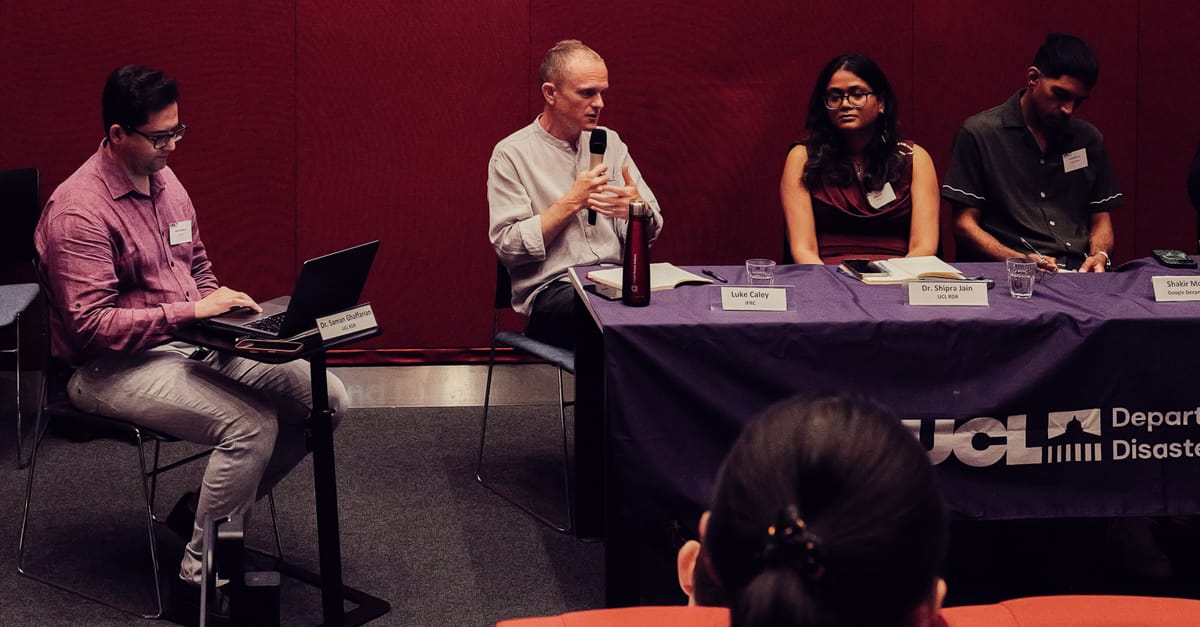
The choice of "responsible intelligence" over "responsible AI" was deliberate: it relocated responsibility from the model to the judgement and institutions exercising it. Each panellist returned to the point - a model is never responsible, nor capable of judgement; the people and systems around it are.
Machine learning is central to my research, and the question it keeps returning me to is sovereignty – which, under the current generation of AI infrastructure, is better understood as layered than singular:
- Data - who holds and controls the satellite or geospatial image data?
- Model - who trains and owns the weights?
- Compute - whose hardware runs inference?
- Epistemic - who determines what constitutes a fire or risk priority?
Most discussions of African AI capacity stop at the data layer, equating autonomy with open access to the public Sentinel and Landsat archives. Yet openness at the data layer can coexist with total dependency at every layer above it: a state may hold the imagery of its own territory while the models, the hardware, and the very definition of the detection task all reside elsewhere. A country can become, in effect, a product of its own data — its imagery freely available, yet its interpretation owned by others.
The precarious nature of the upper layers is not hypothetical. In June 2026, the United States government issued an export-control directive, citing national-security authorities that required Anthropic to suspend all access to two of its frontier models – Fable 5 and Mythos 5 - by any foreign national worldwide. As that access could not be selectively segmented, a capability available globally one day was gone the next – withdrawn by a single government's directive, with no consideration of dependency or impact.
Responsible Intelligence Highlights
Human-Centric Responsibility: AI is not inherently responsible; responsibility arises from human agency, governance, and sociotechnical ecosystems. Critical decision-making, especially in ambiguous and high-stakes disaster scenarios, must not be fully automated.
Trust and Transparency: Building institutional trust is paramount. This requires radical transparency in methodologies, clear accountability structures, a willingness to openly publish and learn from failures, and ensuring that the systems themselves are trustworthy.
AI should complement, not replace, physics-based forecasting. Evaluation metrics must align with real-world risk reduction, as common smooth-field metrics can be misleading. Models trained on reanalysis data can inherit biases, necessitating parallel development.
The "Last Mile" and Equity: There is a fundamental tension between creating generalised models and addressing specific community needs. For AI to be responsible, its benefits must reach affected communities, who should be able to understand, challenge, and influence the systems that impact them. Data-poor contexts and averaging effects risk reinforcing marginalisation without considered, participatory design.
Systemic Governance: True accountability requires multi-layered systems of cultural norms, internal reviews, external regulations, and partnerships, rather than resting on a single individual.
Ethical and Environmental Costs: A significant ethical conflict exists in using computationally expensive AI, with its large carbon footprint, to solve problems like climate change. The true environmental and social costs of large-scale AI development, including the use of public data and natural resources, are a major concern and how these can be addressed within planetary limits.
Grateful appreciation to the panellists: Saman Ghaffarian (Chair) Luke Caley (Red Cross) Dr Shipra Jain (UCL RDR) Shakir Mohamed (Deepmind) Ruzin Saleem (10 Downing Street)
Catastrophe Modelling Panel
The panel convened to discuss ‘Why are increasingly sophisticated risk models not yet shaping infrastructure decisions in cities?’ was chaired by Roberto Gentile with panellists Fatemeh Jalayer (UCL RDR), Salvatore Lacoletti (Travelers), Robert Muir-Wood (Moody's Risk Management Solutions) and Solomon Karani (UN Habitat).
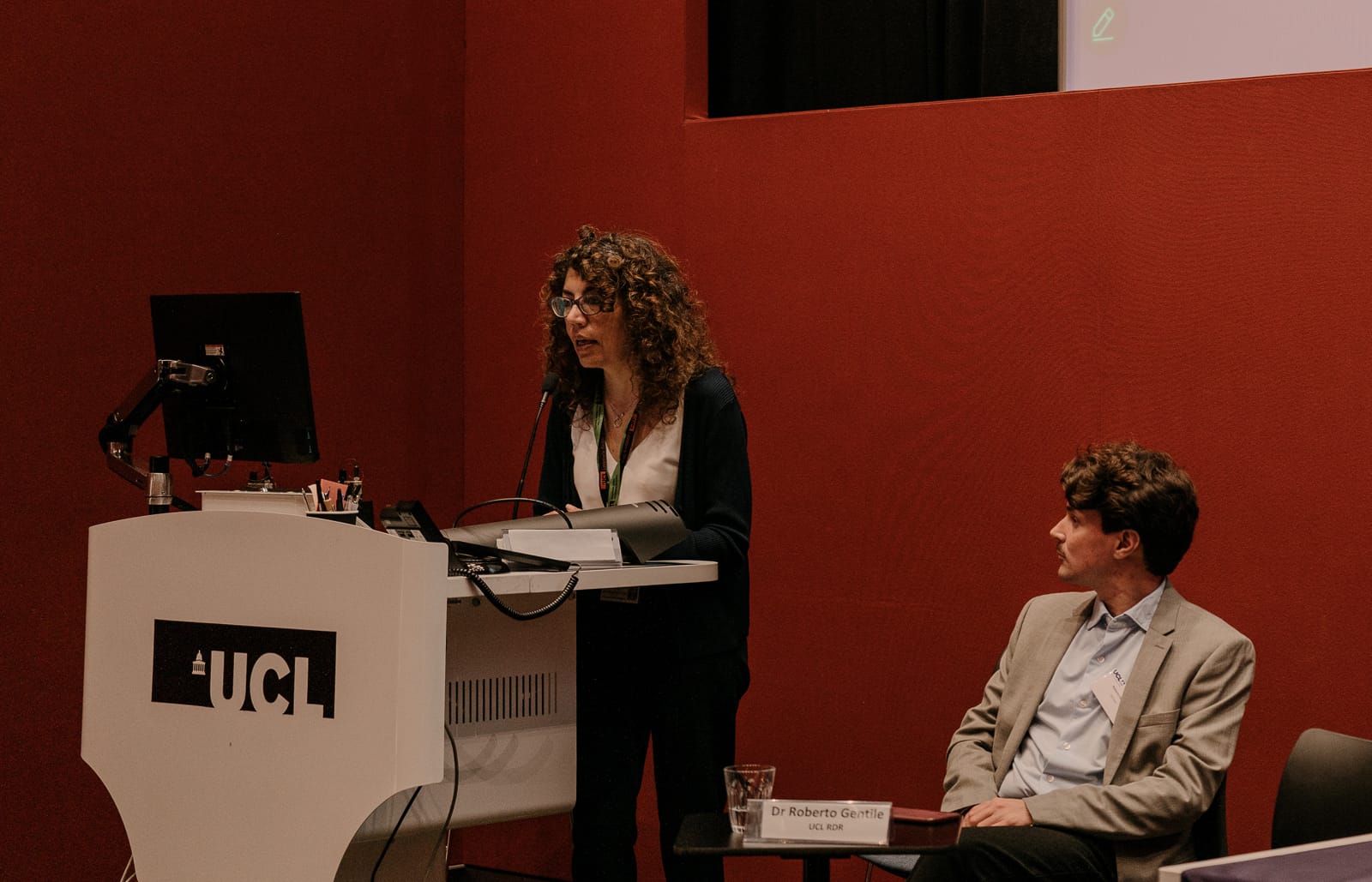
Experts from academia, commercial modelling, and the insurance industry were aligned in their view that complex risk models are underutilised for city planning due to a disconnect between model outputs and the practical needs of decision-makers.
Catastrophe models and ML models converge on the same demand: participatory, user-centred design – close attention to the end user across both application and capability – runs through every prediction model I'm working with. Transparency and explainability are non-negotiable, both for building trust and for enabling iterative development. Assumptions, limitations, and evidence quality must be declared and openly documented from the outset, whether the model is treated as decision-ready or as one input among many.
Catastrophe Modelling Highlights
Academics prioritise scientific completeness over usability, and there is a preference to shift toward decision-ready, systemic, and co-produced solutions. This includes moving from static risk metrics to dynamic decision metrics that account for infrastructure interdependencies.
Co-designing tools with stakeholders or using participatory design was stated as a vital mechanism to improve the interface between sectors. Scientists often hesitate to create "decision-ready" products due to concerns around professional accountability.
The concept of "disaster risk auditing" was surfaced as a way to set and track measurable risk reduction targets - halving earthquake deaths for example. A failed initiative in Tokyo was held up as evidence of political reluctance to adopt such transparent measures, as leaders fear being held accountable for not meeting public goals.
The problem is not a lack of models but a failure to use them effectively. Simpler, multi-hazard, forward-looking risk assessments that incorporate equity, ease of interpretation and provide clear cost-benefit analyses need to be prioritised. There is also a need for greater investment in end-user capacity building and integrating models into long-term policy to create accountability.
The discussion touched on the tension between whether modelers should adapt their outputs for decision-makers or if decision-makers should become more adept at interpreting scientific models.
Structural mismatches exist (within the insurance industry) – the one-year time horizon of regulators conflicts with the decades-long planning cycle required for urban resilience projects.
Grateful appreciation to the panellists for their respective contributions: Roberto Gentile with panellists Fatemeh Jalayer (UCL RDR), Salvatore Lacoletti (Travelers), Robert Muir-Wood (Moody's Risk Management Solutions) and Solomon Karani (UN Habitat).


