
I was at the UCL 200 Mathematics Symposium this week – a programme comprised of a day of lectures by an outstanding cast of speakers. Quite a few people have asked me about it so I thought I'd share some reflections and links to interesting references and papers that were mentioned.
Although I sit within MAPS (Mathematics and Physical Sciences), days like this one - built around public engagement - are exactly when you get to discover research well beyond your own corner of the field.
It was also a welcome break from my own research, which swings between typing qstat - the command-line utility that tells you whether your job has cleared the queue on UCL's high-performance research computing cluster - and chasing replies for the qualitative side of the work.
Prof. Hannah Fry, as the keynote, opened and shared that (as an alumna & professor) that she fled UCL over 'unmanageable library fines'. Besides evading the long arm of the librarians, she covered data analysis and algorithms, talking about how hidden patterns in human behaviour can be revealed. The mathematical complexity and detail were glossed over in favour of narrative, but I've included links to some of her references at the bottom of the article. Using the case of serial killer Harold Shipman (the context to the lead image in this article), she explained how analysing the spatial distribution of crimes can predict an offender's home location. This same mathematical modelling has been successfully used to track mosquito breeding grounds, locate bomb factories, and even identify the artist Banksy. Many of these methods I deploy in my own research.
Prof Adrian Rice gave an engaging lecture on what it was like to be a student at UCL 200 years ago. For its time, UCL was a radical, secular institution, often referred to as the "Godless institution in Gower Street". Students in the 1820s and 1830s were an incredibly diverse mix – some as young as 14. They were studying at the first English university that allowed individuals of all faiths and backgrounds to enrol.
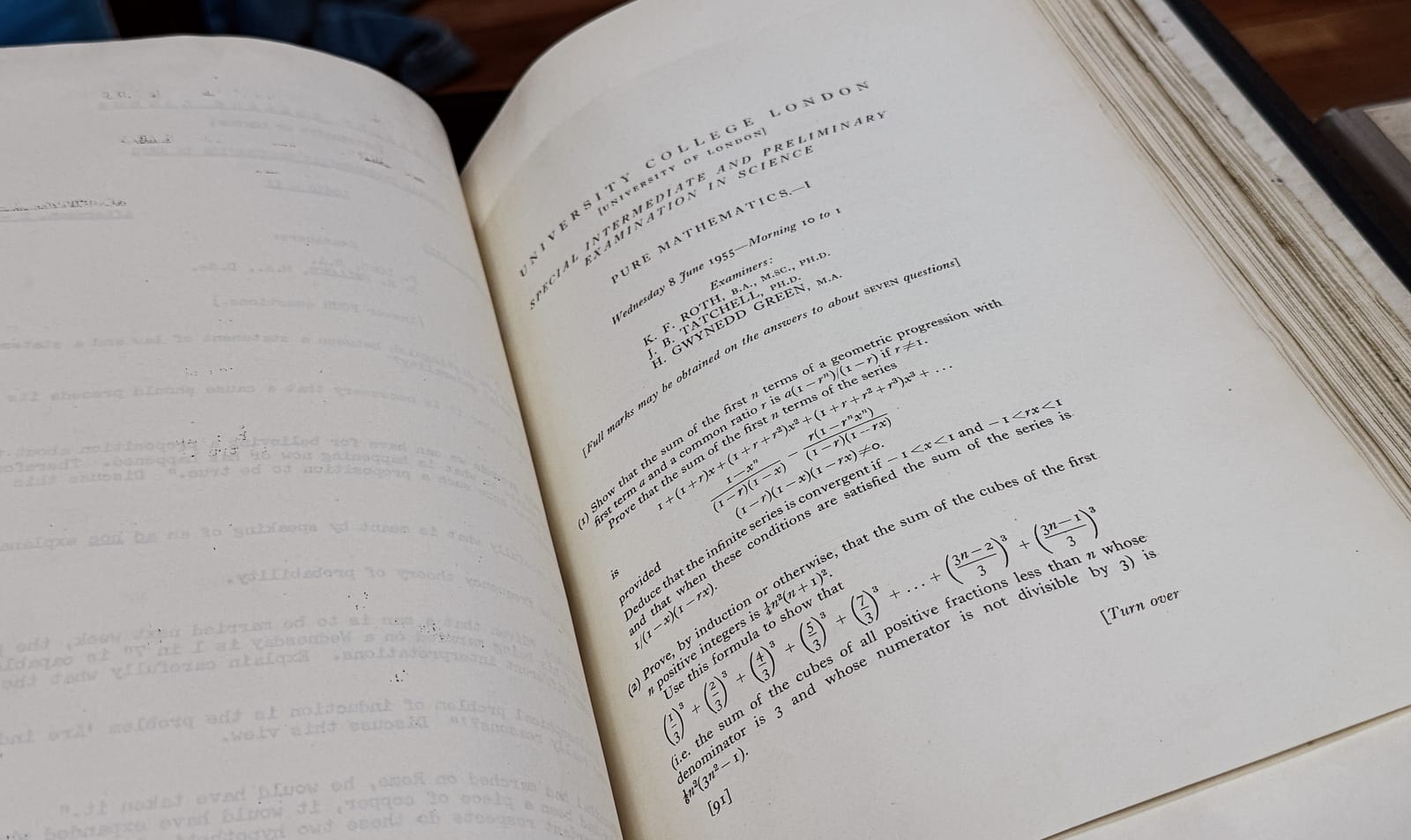
I won't reproduce the entirety of the lecture but Dr Jesse Garrison wrote an excellent overview of the history of the department drawing on the UCL archives and incorporating much of the content of the lecture. Adrian also referenced Ada Lovelace whose connection to UCL stems from her intensive 1840–1841 correspondence course in calculus with Augustus De Morgan, the founding professor of mathematics at UCL. Lovelace later went on to become the head of department. Adrian wrote an interesting article entitled 'Helping Ada Lovelace with her Homework' drawing on these materials and it's interesting to compare the academic standard to current practice and attainment. A substantial number of these antiquarian artefacts are available for viewing via the special collections at UCL and a curated selection were on display at the event.
Prof Dr Nira Chamberlin's high-energy lecture on “The mathematics that can stop an AI apocalypse” was set to a blend of hip hop, 'Obamahood' and the classical "Gambler's Ruin" problem. Nira modelled the competitive dynamics of AI in the business world and demonstrated (mathematically) how to prevent an artificial intelligence monopoly or takeover. He also went on to reflect on the basis of AI development - "would you design a supercar without brakes?" Advocacy for precautionary measures to ensure that AI remains under human supervision appears to be disregarded in the current arms race.
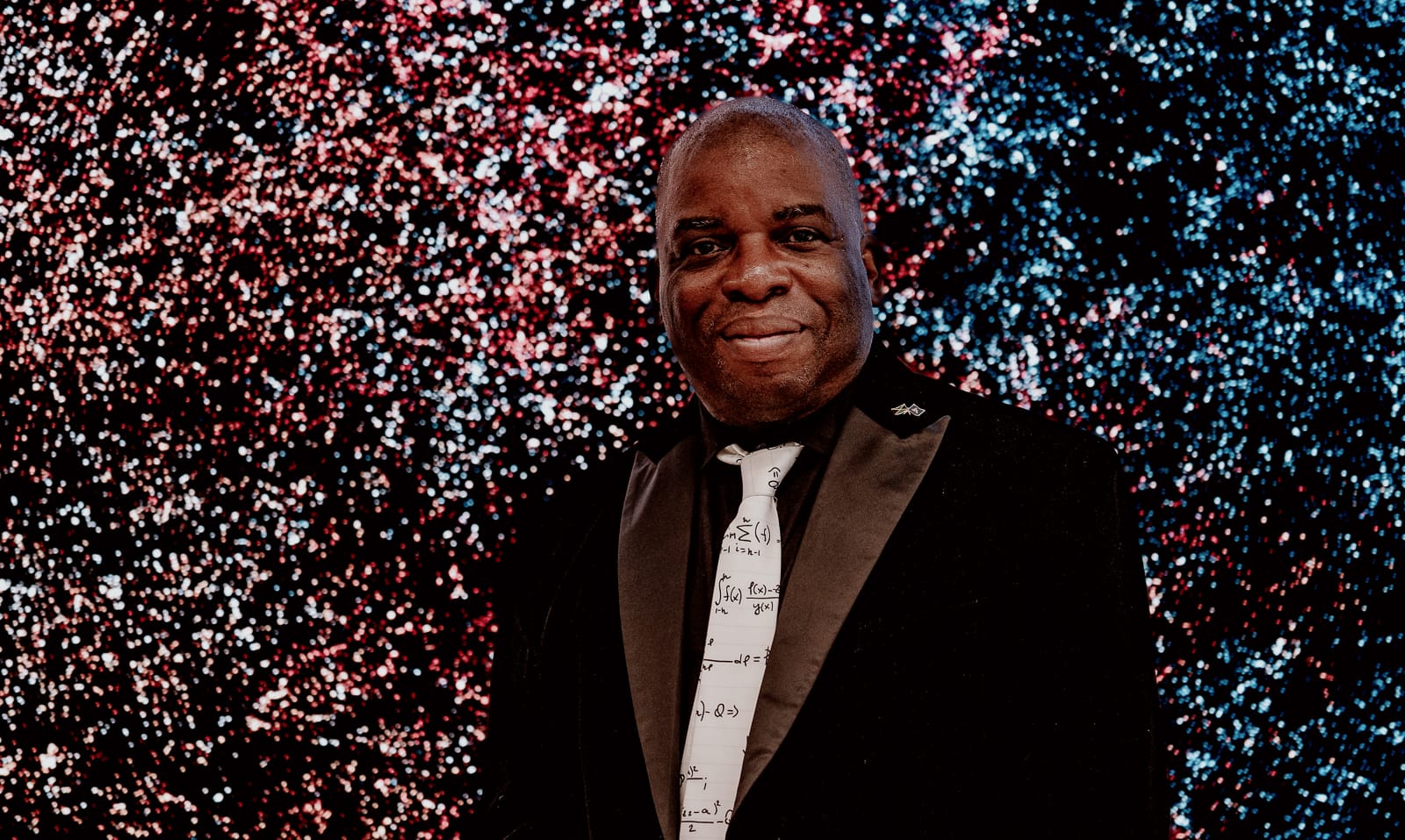
I actually bumped into Nira later and shot the image (below) of him in front of the UCL Eye. UCL Eye (in the North Cloister) is a new interdisciplinary research and visualisation platform built around a high resolution, high dynamic range display wall. It's designed as a literal "window" or "eye" into the sheer volume of data being produced by UCL researchers, turning raw information into public art.
I managed to miss one of the lectures in my enthusiasm for lunch but was on time for Prof Christina Pagel whose lecture entitled “Numbers don’t lie - but they can mislead, the numbers can be wrong, and they can be the wrong numbers” felt like it was going to be an expansion of "Lies, lies, lies and damn statistics".
It was medically focused and Christina's points about the different ways that a test can be right on the basis of specificity and sensitivity resonated. In essence, high sensitivity - fewer missed cases, high specificity - fewer false alarms. They usually pull against each other because they're set by where you place the decision threshold. Loosen it - more true cases but that comes with more false alarms. Tighten it and the reverse happens. A single test doesn't have one fixed accuracy metric; it has a whole curve of sensitivity/specificity pairs (ROC curve plot). An issue I am dealing with in relation to burn scar classification but I don't have a patient asking 'given a positive result, what's the chance that I really have this disease?'
Christina also writes an interesting newsletter on Substack.
I attended the lectures by Prof Mahir Hadžić (partial differential equations describing self-gravitating stars and constructions of explicit collapsing solutions) and Prof Christian Böhmer (modified gravity theory, dark matter and dark energy) but the maths is beyond my grey matter. I will not do them the disservice of trying to describe their research but if cosmology is an interest area, they are at the forefront of academia and you should follow their work.
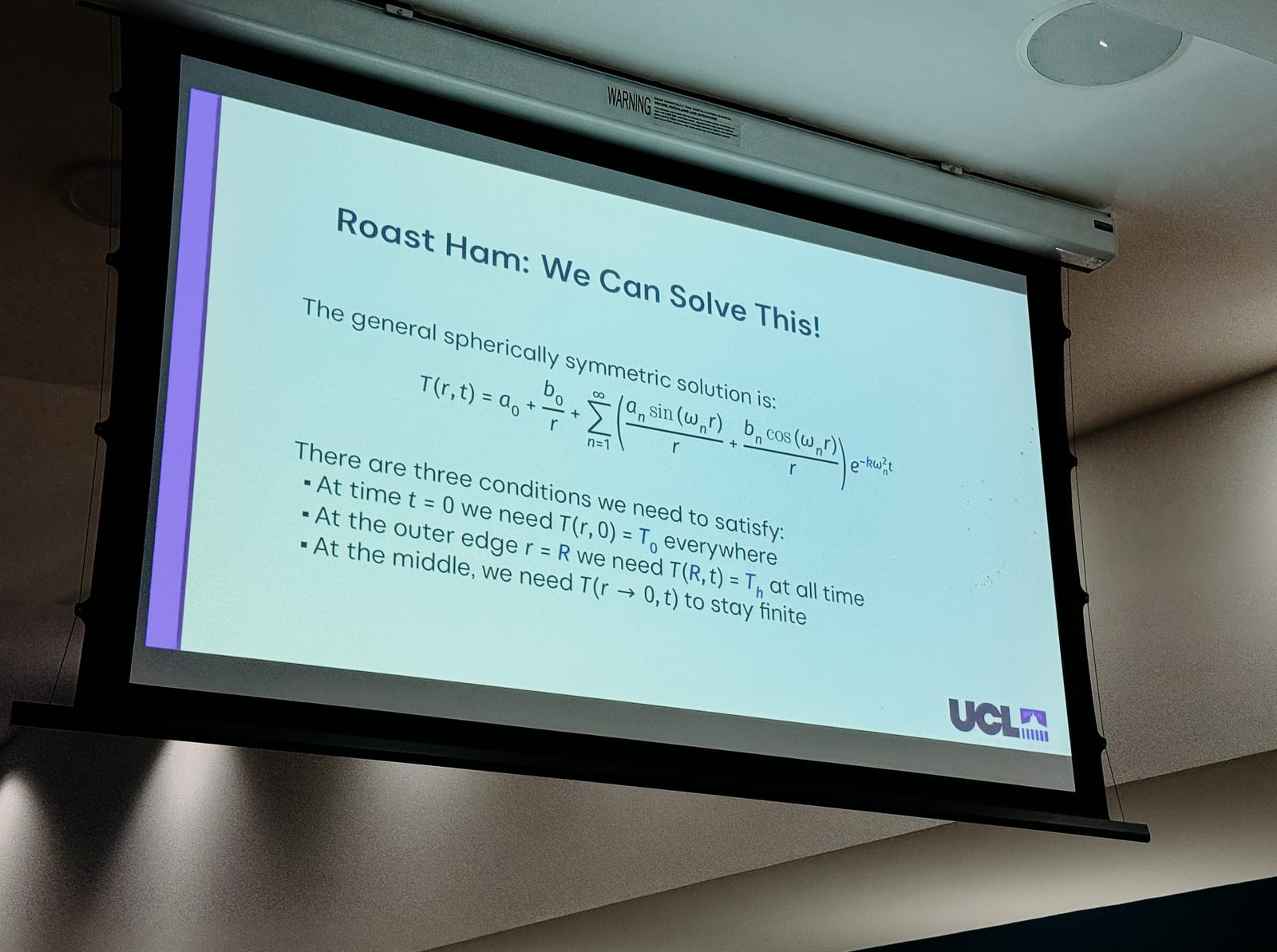
Prof Helen Wilson's lecture on 'Mathematics in the Kitchen' was really interesting and began by focusing on the fundamental differences between simple liquids and structurally complex, non-Newtonian fluids like custard and molten chocolate (the chocolate fountain experiment caught the media's imagination in a slow news week). The lecture finished on 'solving roast ham' and I now suspect cookbooks settled for an approximation where the ham deserved a solution. There is a variation of this lecture that Helen did at Gresham College a few years ago.
Public engagement days like this at UCL matter because science only becomes useful once it leaves academic journals. People don't act on data; they act on stories. Narrative makes abstract findings memorable, shareable and human.
The brain is built to remember characters and consequences, not coefficients and confidence intervals. Effective engagement isn't about dumbing complexity down – it's about making it accessible: presenting work in a way that earns attention, builds trust and lets people see why it matters.
It also makes science accountable and democratic, inviting participation rather than leaving the questions that affect people locked in abstract language. Increasingly it's what funders, journals and institutions expect - a shift captured in the very title Hannah Fry now holds at Cambridge: Professor of the Public Understanding of Mathematics.
"You have to think about how the work that you have created is going to be seen by other people and how it is going to be understood and misunderstood. This is a crucially important and often overlooked aspect of our work" - Professor Hannah Fry
The Wikipedia "Philosophy" Game
Significance: An analysis of the entire Wikipedia network confirmed this pattern for 97% of pages. It serves as a metaphor for an underlying mathematical world (the network structure) that contains insights explaining patterns in the tangible world (casual browsing).
- Primary Source: Wikipedia Community Meta-Project.
- Contextual Literature: Structural network analysis regarding scale-free properties in massive complex networks (e.g., Albert-László Barabási's research on network hubs).
Data Stories on Human Behavior
OKCupid Attractiveness Ratings
Significance: An analysis of user ratings showed men rated women on a normal distribution, while women were much more selective, rating only one in six men as above average. This divergence suggests men initially prioritize looks more than women.
- Primary Source: Rudder, C. (2009). Your Looks and Your Likes. OkTrends Blog.
- Book Companion: Rudder, C. (2014). Dataclysm: Who We Are (When We Think No One's Looking). Crown Publishing.
Geotagged Tweets in London
Significance: A map of non-English geotagged tweets revealed linguistic communities (e.g., Arabic in West London, Russian in central London) and the city's physical structure (e.g., outlines of Wembley Stadium). However, a supposed "French community" was found to be just one prolific tweeter, underscoring the need for data verification.
- Primary Source: Cheshire, J., & Manley, E. (2013). Mapping London's Twitter Languages. Centre for Advanced Spatial Analysis (CASA), University College London (UCL).
- Book Companion: Harford, T. (2021). The Data Detective: Ten Easy Rules to Make Sense of Statistics (Published as How to Make the World Add Up in the UK). Riverhead Books.
The Baby Boy Birth Ratio Phenomenon
Significance: A 170-year dataset from England and Wales shows that slightly more boys are born than girls and that this ratio spikes after major stressful events like wars (1919, 1945) and national crises (1973). The scientific explanation is biological: at a population level, more frequent intercourse (e.g., after soldiers return from war) leads to conception occurring earlier in the menstrual cycle, which slightly favors the conception of male children.
- Primary Dataset: Office for National Statistics (ONS). Birth characteristics in England and Wales.
- Core Biological Literature: James, W. H. (1987). The human sex ratio at birth. Human Biology, 59(5), 721-752.
- Secondary Context: Grant, V. J. (1994). The maternal dominance hypothesis. Biological Reviews, 69(3), 333-347.
Application of Mathematical Algorithms
Farming (Precision Livestock Tracking)
Significance: Farmers use wearable devices on cows to detect the moment they go into heat. This allows for precisely timed artificial insemination to increase the probability of conceiving a female calf, which is often more profitable.
- Industry Reference: Commercial implementations of Precision Livestock Farming (PLF) algorithms, such as those pioneered by Idenomix, Moocall, or the AI platform Connecterra.
- Literature Context: Rutten, C. J., et al. (2013). Sensor technology in dairy farming: a review. Computers and Electronics in Agriculture, 96, 208-222.
Corporate Management (Organizational Network Analysis)
Significance: A Hungarian tile company mapped its internal social network and discovered that the most influential employee was not a manager but an entry-level safety officer who was an effective gossip. Instead of firing him, they leveraged his influence by making him a conduit for official company information.
- Primary Source Case Study: Executed by organisational network analysis firms in Central Europe (notably featured in network theory profiles by J. Kleinberg and A.L. Barabási).
- Book Companion: Fry, H. (2018). Hello World: Being Human in the Age of Algorithms. W. W. Norton & Company.
Artificial Intelligence in Understanding Animal Language
Decoding Vocalizations with LLMs
Significance: Large language models (LLMs) analyze the structure of recorded animal sounds to find patterns, similar to how they map human languages. The goal is to identify a "language shape" and common themes like "mother," "food," or "danger."
- Primary Source Initiative: Earth Species Project (ESP). Using self-supervised machine learning to map non-human vocal communication topologies.
Elephant Communication Case Study
Significance: Research in Kenya has shown that elephants have specific vocalizations that function as names for each other. They also have a distinct "word" for "bee," which, when played back, causes other elephants to flee. This discovery has led to proposals for humane wildlife management, using sound to keep elephants away from farms. Elephants also appear to have a word for "human."
- Published Journal Article: Pardo, M. A., Fristrup, K., Lolchuragi, D. S., Poole, J. H., Granli, P., Moss, C., Douglas-Hamilton, I., & Wittemyer, G. (2024). African elephants address one another with individually specific name-like calls. Nature Ecology & Evolution, 8(7), 1353-1364.
Vocal Simplicity
Significance: In contrast, some animals like the male elephant seal have simple communication, essentially just shouting their own name.
- Primary Literature: Casey, C., et al. (2015). Vocal signatures of male northern elephant seals. The Journal of the Acoustical Society of America, 137(4), 2211-2211.
Mathematical Modeling for Crime and Beyond (Geographic Profiling)
The Harold Shipman Case
Significance: Data analysis of the time of death of the serial killer doctor's patients showed a large, anomalous peak in the afternoon, which was a key indicator of his crimes.
- Primary Judicial Source: The Shipman Inquiry (Third Report). (2003). Death Certification and the Investigation of Deaths by Coroners. UK Department of Health.
- Statistical Analysis Reference: Kinnell, H. G. (2000). Serial homicide by doctors: Shipman in perspective. BMJ, 321(7276), 1594-1597.
- Book Companion: David Spiegelhalter. “The Art of Statistics: Learning From Data (Pelican Books)”
- Open-Source Data Explorations: Kaggle Notebook: Analysis of Harold Shipman Victims (Exploratory data analysis mapping the historical dataset of victim ages, gender distributions, and the defining afternoon time-of-death anomaly).
Geographic Profiling Technique & Broad Applicability
Significance: This method uses the locations of multiple crimes to create a probability map of where an offender is most likely to live. It is based on the "distance-decay function"—the idea that offenders commit crimes near their home but not right on their doorstep, creating a "buffer zone." The same mathematical principle is used to track mosquito breeding grounds by mapping malaria cases, locate bomb factories from detonation sites, and has been used in an attempt to identify the artist Banksy.
- Core Methodology Source: Rossmo, D. K. (1999). Geographic Profiling. CRC Press.
- The Banksy & Disease Vector Application: Hauge, M. V., Stevenson, M. D., Rossmo, D. K., & Le Comber, S. C. (2016). Tagging Banksy: using geographic profiling to investigate a modern art mystery. Journal of Spatial Science, 61(1), 185-190.


